Arrest Records give instant insight into subject details, booking dates, and the agency involved, letting users trace misdemeanor or felony charges without delay. An arrest record search by name or location pulls data from the county arrest database, showing charges, custody status, and court dispositions. For Kane County inquiries, the official sheriff’s office at 37W755 Illinois Route 38, St. Charles, IL 60175 holds the primary source files.
Arrest Records also include booking photos, warrant status, and any public file redactions, helping verify identity while respecting juvenile restrictions. Users can perform an arrest records lookup by date or case number to see updates on expunged or sealed files, and learn the legal presumption of innocence. Frequently asked questions cover update speed, required request information, and how to confirm unlisted entries.
How to Search Arrest Records
Arrest records cover several stages, from the police arrest and jail booking to later court filings. In addition, consulting official kane county records confirms that a record search can match a person with an arrest date, alleged charge, arresting agency, custody status, or case number. Its main purpose is to locate the correct official record or request a copy when a public listing does not show enough detail. In Kane County, the Sheriff’s Office handles records arising from its own police and jail operations, and the court system holds filings and case outcomes.
Official Search Portal: https://www.kanesheriff.com/pages/contacts.aspx
Steps to Search
- Open the official Kane County Sheriff’s Office page and confirm that the request concerns the Sheriff’s Office or its jail.
- Prepare the legal name, known aliases, arrest or booking date, arrest city, arresting agency, and any booking or case number.
- Call the main office during posted hours and ask whether a live public search exists, what identifiers it accepts, and which period it covers.
- Compare each result by date, agency, custody status, and record number rather than by name alone.
- Ask for the current request method for a record copy or certified copy, and ask which court office handles related filings.
Arrest Record Search Methods by Name, Date, and Location
Searching arrest records works best when each search term narrows both the person and the event. A name alone can produce unrelated results, so use the most precise identifiers accepted by the source system. The arrest history for one person may also span more than one agency or court.
Use at least two matching facts before treating a result as the same person. A shared name plus the same arrest date is stronger than a name by itself, while a full booking or case number can give the cleanest match. Review the agency and custody status before opening or requesting a record.
If an arrest lookup by name returns nothing, confirm the spelling, try known aliases, widen the date range, and identify the correct arresting agency. A missing result does not prove that no arrest occurred. The person may have been released before a public roster update, booked under another agency, or placed in a restricted file.
Record Information and Charges
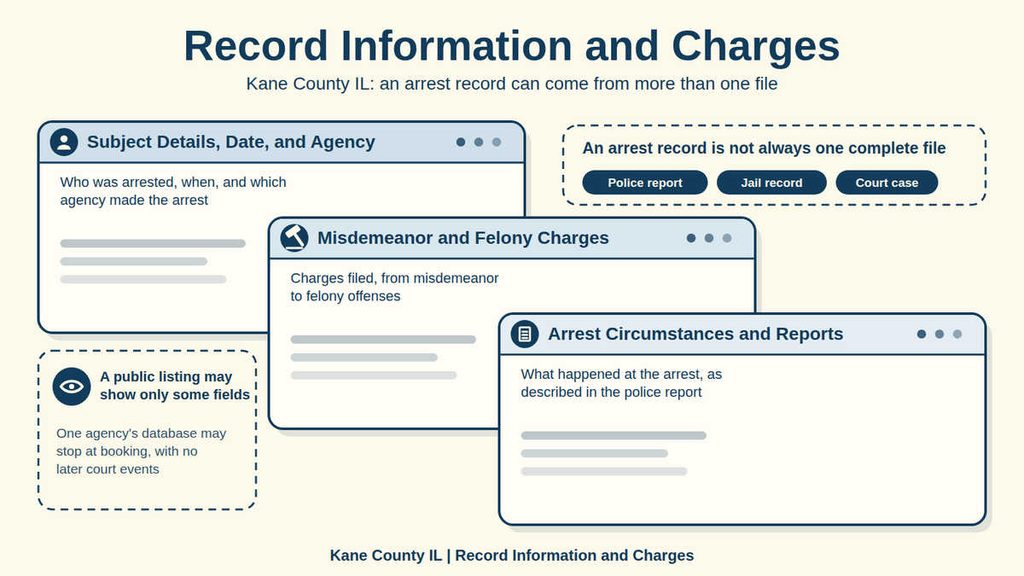
An arrest record is not always one complete file. A police report describes the arrest event, a jail record tracks custody, and a court case records charges, hearings, and the outcome. A public listing may show only some fields from these sources. The arrest database for one agency may also stop at booking rather than contain every later court event.
Subject Details, Date, and Agency
Subject details help confirm that a result belongs to the correct person. The record may contain a legal name, middle name or initial, alias, date of birth, physical description, and a unique booking number. Some public systems omit birth dates or show only a limited form of the name, which makes two matching fields more important.
Date and agency fields also prevent a common mismatch. The arrest date, booking date, court date, and release date can all fall on different days. The arresting agency may differ from the agency that operates the jail, so a search for the wrong police department can miss a person held at the same facility.
Misdemeanor and Felony Charges
A misdemeanor or felony label describes the charge connected to the arrest or booking. One arrest may list several charges, and an initial charge may later change through a legal filing. The charge shown on a jail listing does not show the final court decision.
Court records are the proper source for amended charges, dismissed charges, plea decisions, acquittals, convictions, and sentences. A booking entry that lists a felony does not establish that the person was convicted of that felony. A later disposition can point to a different charge or end with no conviction.
Arrest Circumstances and Reports
An arrest report may describe the alleged conduct, arrest time and place, officers involved, property taken, statements recorded at booking, and the reason for detention. The exact packet depends on the agency and case. A short jail entry may contain none of the narrative details found in a full police report.
An arrest report search is separate from a roster lookup. The office may need a report number or case number, and the report may exist in a different file from the booking entry. Some pages may be withheld or redacted under applicable law or office policy, so a missing page does not always mean the event never occurred.
Custody and Associated Judicial Records
Booking and court records answer different questions. Booking records show what the jail recorded when the person entered custody. Court records show the charges filed, appearances made, decisions issued, and final case outcome. A complete arrest history often requires records from both sources.
Booking Details and Facility Location
For a person held in jail, the booking record can provide several fields that make an arrest easier to verify.
- Booking date and time: This may differ from the arrest date because of processing time or an earlier hold.
- Booking or inmate number: This serves as a unique reference for the custody event and may appear on reports, court papers, and release records.
- Custody status: Listings may show active detention, released status, transferred status, or another current category.
- Facility location: The jail or detention center listed may differ from the place where the arrest occurred.
- Release or transfer record: A later date can show that the person left one facility or moved to another agency.
The booking number is often the best field for confirming that two records refer to the same custody event. A date and agency name can provide support when the number is missing or partly hidden.
Warrant Status and Arrest Context
A warrant record is separate from the arrest report and can change at any time. Search results may refer to a warrant as issued, active, or executed, though each system may use different labels. The same person can have more than one warrant in different courts, so one search result does not describe the complete warrant picture.
An arrest can occur with or without a warrant. Missing warrant data therefore does not cancel an arrest entry. For current status, use the number shown in the result and confirm it with the agency that supplied it or with the court named in the entry.
Court Case Filings and Disposition
A court file may contain the initial appearance, bond setting, charging document, pretrial records, plea, dismissal, conviction, acquittal, or sentencing. The file can also connect a jail booking to a court case number, which helps trace the event beyond custody.
In Kane County, the Circuit Court Clerk handles court filings and case records. To assist researchers, official recent arrests documentation shows that the Sheriff’s Office can confirm the arrest and custody side, while the court file controls the legal case outcome. Joining the booking number, case number, party name, and court dates gives a stronger case history than a name-only search.
Photographs and Public File Requests
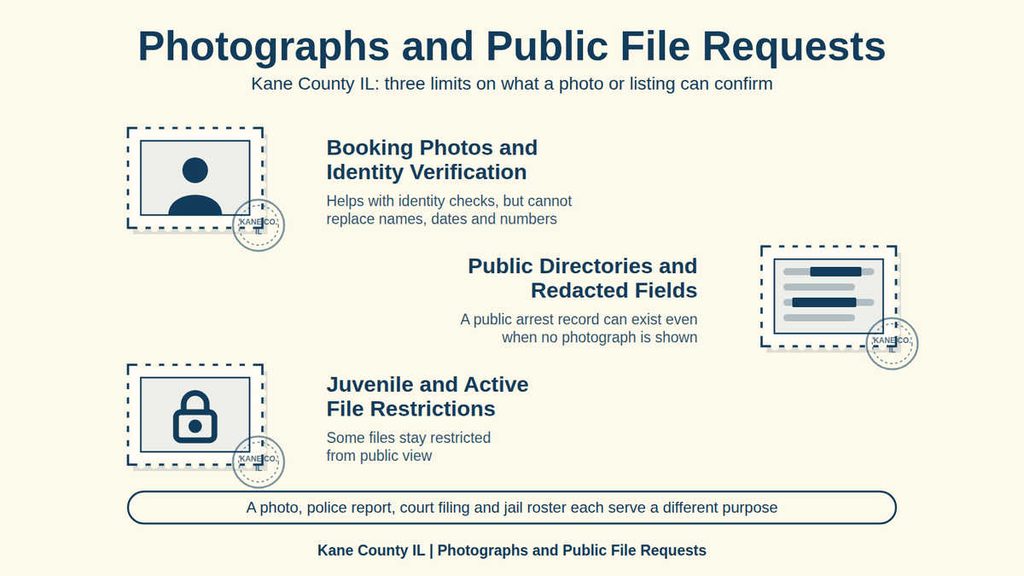
A booking photograph, police report, court filing, and current jail roster serve different purposes. A photograph may help with identity checks, but it cannot replace matching names, dates, and numbers. A public arrest record can exist even when no photograph appears in a public listing.
Booking Photos and Identity Verification
A booking photo is an image made during the intake process. Public jail listings may display one beside the person’s name, booking date, charge, or custody status. The photo can help distinguish people with similar names, yet a photo alone cannot confirm a person’s identity or current custody status.
Compare a photo with several fixed details, including the booking number, date, agency, and listed charge. Appearance can change over time, and an old photo may remain in a record after the person has been released. Some arrest logs do not carry photographs at all, while other systems remove or hide an image after a case or custody change.
Public Directories and Redacted Fields
An online arrest database may take the form of a public directory rather than a complete historical archive. A current roster can include only the person’s name, booking number, booking date, charge, facility, custody status, and photograph. An archived case request may reach back farther and include documents that the directory omits.
Ask the Sheriff’s Office which public directories are live, which agencies contribute to them, and whether they cover current detainees, released people, or a longer period. A missing released record may reflect the directory’s scope. It may also reflect a redaction, a change in custody status, or a separate court case.
Redacted fields may conceal a photograph, a portion of a narrative, personal details, or material connected to an open investigation. A redaction means that the stored record and the public version are different. Do not assume that a blank field proves no arrest, charge, or custody event exists.
Juvenile and Active File Restrictions
Illinois juvenile records have statutory confidentiality protections and limited exceptions for public access. A juvenile booking photo, police report, or court file should not be treated as openly viewable merely because an adult arrest listing is public. State the person’s age at the time of the event when requesting a juvenile-related record so staff can apply the correct rules.
Sealed cases, juvenile matters, and some active investigative files can have separate access limits. An active warrant or open case also needs current status from the source court or agency. Ask for the file type and legal status before requesting a full report, since a current roster entry may carry fewer restrictions than the underlying document.
Record Accuracy and Resolution
Arrest records can differ across a jail listing, police report, and court file because each source updates at its own pace. A conflict often points to a processing delay, a changed charge, a custody transfer, or a restricted document. The correct response depends on which field is disputed.
Update Delays and Missing Records
Resolve the disputed field at its source. A jail roster can confirm custody details, a police agency can confirm its arrest report, and a court clerk can confirm filed charges and case outcomes. Keep the booking number and case number with the request because names alone can send a request to the wrong record.
Expunged and Sealed File Removal
Expungement and sealing can change whether an arrest record remains open to public requests. To assist researchers, official sex offenders documentation shows that an expungement may remove eligible court records, while a sealing order limits release under the law and terms of that order. The effect on a separate police or jail listing can differ because those agencies may hold records under their own duties and reporting rules.
An online listing may remain visible after a legal change, or it may disappear before every linked index has been updated. A visible entry does not by itself prove that the full record remains open, and a missing entry does not prove that an expungement occurred. Confirm status with the agency or court that holds the source file using the name, date, booking number, or case number.
Legal Presumption of Innocence
The legal presumption of innocence treats a person as not guilty until guilt is established through the court process. An arrest record shows that police took someone into custody. A charge states the allegation brought by the prosecutor, and a conviction records the court’s final finding after the case proceeds.
Those records can verify dates, agencies, custody status, charges, and case outcomes, but they do not justify treating an arrest as proof of guilt. Keep the arrest, charge, and disposition distinct when checking a person’s history. If a result appears wrong, request the source record and use the appropriate correction process for that agency or court.
Contact Details
Use this contact block for questions about Kane County Sheriff’s Office records. The main phone line handles general office inquiries, while a separate dispatch line is available for non-emergency police contact. Call during regular business hours when possible to confirm the appropriate department. For specific records requests, ask about applicable procedures, availability, and any associated fees before submitting your inquiry.
Frequently Asked Questions
Arrest records let you confirm a person’s legal history, verify court dates, and locate official documentation. Accessing these files helps employers, landlords, and families make informed choices while staying within public‑record rules.
How can I search arrest records by name in Kane County?
Visit the Kane County Sheriff’s website and use the online arrest record search tool. Enter the full name, then select the desired date range or arresting agency. The system returns matches with case numbers, charges, and booking status. If the online list lacks detail, call the main office at 630‑232‑6840 to request a copy.
What steps are needed to look up arrest records by date?
Start on the sheriff’s portal and choose the “search by date” option. Input the exact arrest date or a range, then click submit. Results show all arrests on those days, including names and agencies. For older dates, contact the records division; they may require a written request and a small fee.
Can I find arrest records online for a specific arresting agency?
Yes. The online database lets you filter by agency name. Select the agency from the dropdown, add any name or case number you have, and run the search. The output lists each incident with charge details and current custody status. If the agency isn’t listed, call the agency’s public information office for guidance.
How do I locate an arrest case number when I only know the location?
Use the “search by location” field on the Kane County site. Enter the city, township, or jail name, then apply any known date range. The results include case numbers, which you can copy for court filings or background checks. For missing data, request a location‑specific report from the records clerk.
What should I do if an arrest record online is incomplete?
First, note the case number shown. Call the sheriff’s non‑emergency line at 630‑232‑8400 and ask for the records supervisor. Explain the missing details and request a full copy. Be ready to provide identification and pay any copying fee. The office will mail or email the complete report within a few business days.